To create a new persona, we need to know the information Chat GPT requires. I used the prompt I want to create a customer persona. What information do you need to create it?
Result: Business and product information
This helps me understand what the persona needs from your business.Business or brand name *Products or services offered *
2. Demographic information
Who is your typical customer?Target age rangeGender focusAll gendersMale-focusedFemale-focusedOther or specific audienceTarget location or marketTypical occupations or customer types
3. Psychographic information
What interests your customers and motivates them?Interests, hobbies, and lifestyleGoals and motivationsChallenges and pain points
4. Buying behavior
Preferred shopping channelsOnlineIn-storeBoth online and in-storeNot surePrice sensitivityBudget-focusedValue-conscious; balances price and qualityQuality-focused; willing to pay moreNot sure
5. What will you use the persona for?
Content marketing and SEOBlog post ideas and social mediaAdvertising and campaign planningProduct development and customer researchAll of the aboveAdditional information (optional)
Create my customer persona
What I’ll create from your answers
1. Persona profile
A fictional name, brief biography, demographic profile, lifestyle, interests, and personality traits.
2. Goals and challenges
The customer’s needs, motivations, frustrations, and reasons for choosing or avoiding your brand.
3. Buying behavior
Shopping preferences, purchasing factors, decision-making habits, and preferred channels.
4. Marketing and SEO recommendations
Potential Google search keywords, content topics, messaging ideas, and ways to reach the audience.
My recommendation: Start with the business name, products or services, target audience, customer goals, and biggest challenges. Those five areas give me a strong foundation. I can estimate missing details, but actual customer research will make the persona more reliable.
I will upload the previous persona information I created in my first blog post about CocaCola and upload it into the prompt.
Result: Greg, the Everyday Enjoyer Coca-Cola customer persona · Illustrative profile “I drink it because it tastes good. Sometimes, you just want a little treat.”
Age range 12–45 Gender Any gender Location North America Income Varies Shopping habits Stores and events Primary motivation Taste, enjoyment, and social occasions 1. Demographic information Greg represents a broad audience of Coca-Cola consumers across North America. He could be a student buying a drink after school, a young professional grabbing one during a break, or a parent purchasing beverages for a family gathering. Age: 12–45 Gender: Not gender-specific Location: Primarily North America Education and occupation: Students, professionals, and people from varied educational and career backgrounds Income: Various income levels Marital status and household size: Single people, couples, and families 2. Psychographic information Greg doesn’t fit into one specific lifestyle or interest group. Instead, the persona focuses on the shared motivations that may encourage people to choose Coca-Cola. Motivations: Enjoying good taste, socializing, celebrating, and treating himself. Lifestyle: Varies by age and personal circumstances, with opportunities to enjoy Coca-Cola at home, on the go, or at social events. Values and interests: No single set of values or hobbies defines this audience. Emotional connection: Familiarity, nostalgia, enjoyment, and associations with shared moments. Key insight: Coca-Cola can appeal to Greg as both an everyday beverage and a small indulgence associated with enjoyable moments. 3. Behavioral information
Buying behavior Greg often encounters Coca-Cola in retail stores, convenience stores, restaurants, and event settings. An accessible price, cold availability, and convenient packaging can encourage an impulse purchase.
Product usage Greg drinks Coca-Cola for its taste, enjoyment, and convenience. He may buy it with a meal, during a break, or while spending time with friends and family.
Online behavior The intended younger audience discovers brands through Google, TikTok, Instagram, and sometimes Facebook. Video advertising, entertaining posts, creator partnerships, and recommendations may help influence purchase decisions. Customer journey 1 Awareness Sees a TV commercial, social media post, or advertisement. 2 Interest Recognizes the brand or remembers a familiar taste and experience. 3 Purchase Buys Coca-Cola in a store, sometimes on impulse at the checkout. 4 Enjoyment and loyalty Enjoys the drink and may recommend it to friends or family. 4. Goals and objectives Goal How Coca-Cola may meet the need Quench thirst Offers a convenient beverage to enjoy when thirsty. Satisfy a craving Provides the familiar flavor Greg wants. Enjoy a small treat Offers an indulgent moment during the day. Celebrate life Connects with social gatherings, meals, and celebrations through brand experiences and marketing. One important distinction: although the persona may associate Coca-Cola with refreshment and enjoyment, regular Coca-Cola contains sugar and should not be positioned as a source of meaningful hydration or energy. Its primary appeal here is taste and enjoyment. 5. Objections and concerns Price and affordability Greg may question whether the drink is worth the cost, particularly when shopping on a budget or comparing brands. Product availability An unavailable, warm, or inconveniently located product may lead Greg to choose another beverage. Competition PepsiCo products, particularly Pepsi, compete for consumers’ attention and beverage purchases. His likely purchase question is: “Can I afford this, and do I feel like treating myself?” 6. Influence factors Friends and family: Recommendations and shared habits can reinforce brand familiarity. Celebrities and creators: Endorsements and social campaigns may increase visibility. Advertising: Television, digital video, and social media can prompt brand recognition and impulse purchases. Cultural familiarity: Longstanding associations with meals, celebrations, and social occasions can shape consumer preferences. 7. Customer quotes and real-life examples The following quotes are the examples you provided, not independently verified research interviews. “I drink it because it tastes good.” Motivation: Flavor and enjoyment. “I always had it with dinner as a kid, so now it’s normal.” Motivation: Familiarity and habit. “It’s my guilty pleasure…” Motivation: Indulgence and personal enjoyment. Your example about asking five people whether they recognize Coca-Cola illustrates the brand’s perceived familiarity. To establish actual recognition rates, you would need survey data from a defined sample. 8. Marketing recommendations
1. Encourage impulse purchases Prioritize convenient product placement, cold beverages, clear pricing, and checkout visibility where retailers permit.
2. Connect the brand with shared moments Create campaigns around friendships, meals, celebrations, and everyday treats.
3. Reach younger consumers through social media Test short-form videos, creator content, and interactive campaigns on TikTok and Instagram, adapting content for different age groups.
4. Differentiate from Pepsi Emphasize Coca-Cola’s recognizable brand identity, taste preferences, and associations with shared experiences instead of relying only on price comparisons. Final persona summary Greg represents a broad, convenience-oriented Coca-Cola consumer who chooses the product primarily for taste, enjoyment, familiarity, and social occasions. He may discover the brand through advertising, social media, or people he knows, then purchase it in a store or at an event. Price and availability can affect his decision, while habit and positive associations may encourage repeat purchases. Important limitation: Your age range spans children, teenagers, and adults. Greg is a useful umbrella persona, but one profile cannot fully represent all these groups. For more targeted marketing, consider developing separate personas for Gen Z, millennials, and family shoppers, with age-appropriate messaging and channels.
Non-providable information:
TO fill in the gaps of any information needed, I will ask Chat GPT the following: list the information you think is still needed
Result: Your Coca-Cola customer persona, Greg, has a good foundation. However, some information is still missing or needs further research to make the persona more accurate and useful for marketing. Information still needed for the Coca-Cola customer persona Category Information needed Why it matters 1. Demographics Specific age groups within 12–45 Helps distinguish the needs of Gen Z, millennials, and family shoppers. 2. Geographic details Specific countries, regions, or cities in North America Consumer preferences and purchasing habits may vary by market. 3. Income and budget Typical spending power and willingness to pay Helps determine price sensitivity and effective promotions. 4. Interests and lifestyle Activities, occasions, and daily routines associated with beverage consumption Helps identify relevant marketing opportunities. 5. Values and preferences Preferences regarding taste, sugar, ingredients, packaging, and health considerations Helps explain why customers choose one beverage over another. 6. Purchase frequency How often customers buy Coca-Cola Helps identify frequent buyers and occasional consumers. 7. Purchase locations Specific stores, restaurants, vending machines, and event venues Helps prioritize retail placement and distribution. 8. Product preferences Regular Coca-Cola, Diet Coke, Coca-Cola Zero Sugar, package sizes, cans, or bottles Helps identify which products appeal to different customer segments. 9. Digital behavior Preferred social platforms, content formats, and creators Helps plan digital campaigns and content strategies. 10. Customer journey Specific advertisements, promotions, and experiences that lead to purchases Helps identify the most effective marketing touchpoints. 11. Purchase barriers How much price, availability, sugar content, and competitor products affect decisions Helps address reasons customers might choose alternatives. 12. Competitive analysis Why customers choose Coca-Cola over Pepsi and other beverages Helps clarify Coca-Cola’s competitive advantages. 13. Influences The relative impact of friends, family, celebrities, and advertising Helps prioritize campaign messages and partnerships. 14. Customer feedback Verified survey responses, interviews, reviews, and customer quotes Helps validate assumptions about motivations and preferences. 15. Brand awareness Actual recognition, familiarity, and perception of Coca-Cola Helps establish how customers perceive the brand. 16. Marketing objectives Whether the goal is awareness, trial, repeat purchases, or increased sales Helps make the persona actionable for a specific campaign. The five most important gaps If you want to complete the persona efficiently, I recommend prioritizing these five areas:
1. More specific audience segments Determine whether Greg primarily represents teenagers, young adults, millennials, or parents purchasing beverages for their households.
2. Real purchasing habits Establish how often customers buy Coca-Cola, their preferred product variants, where they buy it, and how much they typically spend.
3. Reasons for choosing Coca-Cola Identify whether taste, nostalgia, habit, convenience, brand loyalty, or social occasions plays the biggest role.
4. Reasons for choosing competitors Find out when and why customers choose Pepsi or other beverages instead of Coca-Cola, including price, flavor, availability, and product preferences.
5. Verified customer insights Gather real feedback through surveys, interviews, or reviews to confirm whether the proposed motivations and objections reflect actual customers. What can be assumed versus what needs research? Reasonable assumptions: Customers may value taste, convenience, familiarity, and enjoyment; social media may help younger audiences discover products. Needs validation: Purchase frequency, average spending, preferred product variants, the strongest purchase motivator, and the reasons for choosing Coca-Cola over Pepsi. Requires a clear marketing decision: Which audience segment and business objective the persona should prioritize. My recommendation: You don’t need to collect every missing detail before proceeding. For a marketing assignment, you can label unavailable details as assumptions. For an actual Coca-Cola marketing campaign, prioritize customer research and purchasing data so the persona reflects real consumer behavior rather than speculation.
Generating customer persona
For the rest of the missing information, I used the prompt: Regarding the following items, we don’t have detailed information. Based on all the general information available to you, guess what they might be like. Chat GPT will fill out the remaining information.
Search engine optimization (SEO)
Keyword research
To demonstrate the ease of searching keywords using AI, I used this prompt: Make a list of the top 5 keywords people use to find information about CocaCola on Google. Separated by comma
The keywords relate to the business by their products and brand name.
Content creation
Blog post idea.
To search blog post idea using AI, I want to capture what the average consumer would be interested in when searching Coca-Cola using this prompt: Write 10 blog post ideas about Coca-Cola that the customer persona created earlier is searching for.
Result: Here are 10 blog post ideas tailored to Greg, the Coca-Cola customer persona. These topics focus on taste, nostalgia, social occasions, convenience, product information, and the everyday enjoyment that motivates Greg to choose Coca-Cola.
10 Coca-Cola Blog Post Ideas
1. Why Does Coca-Cola Taste So Good? The Story Behind Its Iconic Flavor
Explore Coca-Cola’s distinctive taste, its fizz, and why consumers keep coming back for more.
2. Coca-Cola Through the Years: A Look Back at an Iconic Brand
Discover the brand’s history, memorable advertising campaigns, and cultural influence across generations.
3. The Best Occasions to Enjoy Coca-Cola with Friends and Family
Share ideas for enjoying Coca-Cola at picnics, barbecues, birthday parties, movie nights, and other social gatherings.
4. Coca-Cola vs. Pepsi: What Makes Each Cola Different?
Compare flavor preferences, branding, and consumer perceptions to help readers understand why people choose one cola over another.
5. What’s Inside Coca-Cola? Ingredients, Nutrition, and Facts
Explain the ingredients and nutritional information found on Coca-Cola product labels, including sugar content and caffeine where applicable.
6. 10 Fun Facts About Coca-Cola You Probably Didn’t Know
Present interesting facts about the brand’s history, packaging, advertising, and recognizable identity.
7. How to Create the Perfect Coca-Cola Mocktail at Home
Share simple, creative nonalcoholic drink recipes using Coca-Cola, fruit, ice, and other complementary ingredients.
8. Coca-Cola Zero Sugar vs. Original Taste: Which Is Right for You?
Explain the differences in taste, ingredients, and nutritional content so readers can choose according to their preferences.
9. Why Coca-Cola Reminds Us of Childhood: The Power of Nostalgia
Explore how familiar flavors, family meals, and shared memories can influence beverage preferences across generations.
10. How to Keep Coca-Cola Cold and Refreshing for Any Occasion
Offer practical tips for chilling, storing, and serving Coca-Cola at home, on road trips, and during parties.
Recommendation: For Greg’s persona, I would prioritize ideas 1, 3, 6, 7, and 10. They align closely with his interest in taste, social occasions, fun, and convenient enjoyment. The nutrition and product-comparison topics can also attract readers who are researching before making a purchase.
Writing a blog post.
I will choose one of the above options, and ask Chat GPT the following: I want you to act as a blogger with expertise of Coca Cola. You are writing a blog post for “Coca-Cola Through the Years: A Look Back at an Iconic Brand“. This post should be helpful for people learning about Coca-Cola There should be a call to action at the end of each section. The length of the blog post will be 500 words. The tone will be informal. You should write as an individual blogger with a personal approach so do not use plural first-person to refer to yourself. Eg. “our”, or “we”. Only use singular first-person. Do not use passive voice.
Result: Coca-Cola Through the Years: A Look Back at an Iconic Brand
1. How It All Began
Have you ever wondered how Coca-Cola became one of the world’s most recognizable beverage brands? I find its story fascinating because it started with a simple drink and grew into a global phenomenon. In 1886, pharmacist Dr. John S. Pemberton created Coca-Cola in Atlanta, Georgia. Pharmacist and businessman Asa Candler later helped grow the business through marketing and distribution.
Call to action: Discover more about Coca-Cola’s beginnings and explore how one drink started a lasting legacy.
2. Building a Recognizable Brand
Coca-Cola didn’t become famous overnight. The company invested in advertising, distinctive packaging, and a consistent brand identity. Its familiar red color, flowing Spencerian script logo, and iconic contour bottle helped people recognize the product. I think this consistency shows how a clear visual identity can help a brand stand out for generations.
Call to action: Look for Coca-Cola’s signature logo and packaging the next time you visit a store.
3. Coca-Cola Becomes Part of Everyday Life
Over the decades, Coca-Cola expanded beyond its original market and reached consumers around the world. People began enjoying it at restaurants, family dinners, sporting events, and celebrations. Advertising connected the drink with happiness, friendship, and shared experiences. For many consumers, Coca-Cola became more than a beverage; it became part of familiar routines and special memories.
Call to action: Think about a memorable meal or celebration and consider how favorite drinks become part of those moments.
4. Memorable Advertising Through the Years
Coca-Cola has created many memorable campaigns throughout its history. Its holiday advertising helped strengthen the brand’s association with Christmas, while campaigns such as “I’d Like to Buy the World a Coke” promoted togetherness. Today, digital advertising and social media give the brand new ways to connect with audiences. I find it interesting how Coca-Cola adapts its messages while keeping its recognizable identity.
Call to action: Explore Coca-Cola’s classic advertisements and compare them with its latest campaigns.
5. Adapting to Changing Tastes
Consumer preferences change, and Coca-Cola has expanded its product range over time. Diet Coke arrived in 1982, followed by Coca-Cola Zero in 2005, which later evolved into Coca-Cola Zero Sugar. These options give consumers different choices based on taste and dietary preferences. The company continues to compete in a busy beverage market where customers expect variety and convenience.
Call to action: Compare Coca-Cola’s product options and find the one that best matches your preferences.
6. Coca-Cola’s Legacy Continues
Coca-Cola’s journey from a local drink in 1886 to a global brand demonstrates the power of consistent branding, memorable marketing, and cultural connections. Its future depends on responding to changing customer expectations while maintaining the identity people recognize. To me, the most interesting part of its story is how a simple product can become part of everyday life across generations.
Call to action: Share your favorite Coca-Cola memory with friends or family and keep the conversation going.
Social media post
Given the options provided, I chose number 2 so that it provides more background information for a customer to help guide them to the choice of Coca Cola. I then asked ChatGPT to write a LinkedIn post regarding this choice.
Result: 🥤 Coca-Cola Through the Years: A Look Back at an Iconic Brand
Some brands sell a product. Others become part of everyday life. Coca-Cola has spent generations doing both!
From its beginnings in 1886 to its place at family dinners, sporting events, parties, and celebrations, Coca-Cola has built a legacy that goes far beyond a refreshing drink. Its recognizable red branding, memorable advertisements, and classic taste have helped make it a familiar favorite around the world.
What makes Coca-Cola so iconic? For me, it’s the connection between a simple drink and the moments people remember—sharing a meal with family, laughing with friends, or celebrating a special occasion. Sometimes, the smallest traditions create the strongest memories.
As tastes and trends change, Coca-Cola continues to evolve while keeping its recognizable identity. That balance between tradition and innovation offers a powerful lesson in brand building.
💬 Your turn: What’s your favorite Coca-Cola memory? Was it a family tradition, a memorable advertisement, or sharing a Coke with friends? Share your story in the comments!
To create an image to portray our customer persona, I used the prompt below.
I am going to draw a picture regarding the text below using an AI image generator. Write a proper prompt – Coca-Cola constantly strives to develop new products and works hard to provide the best value to its customers. Additionally, it always does its utmost to serve the community.
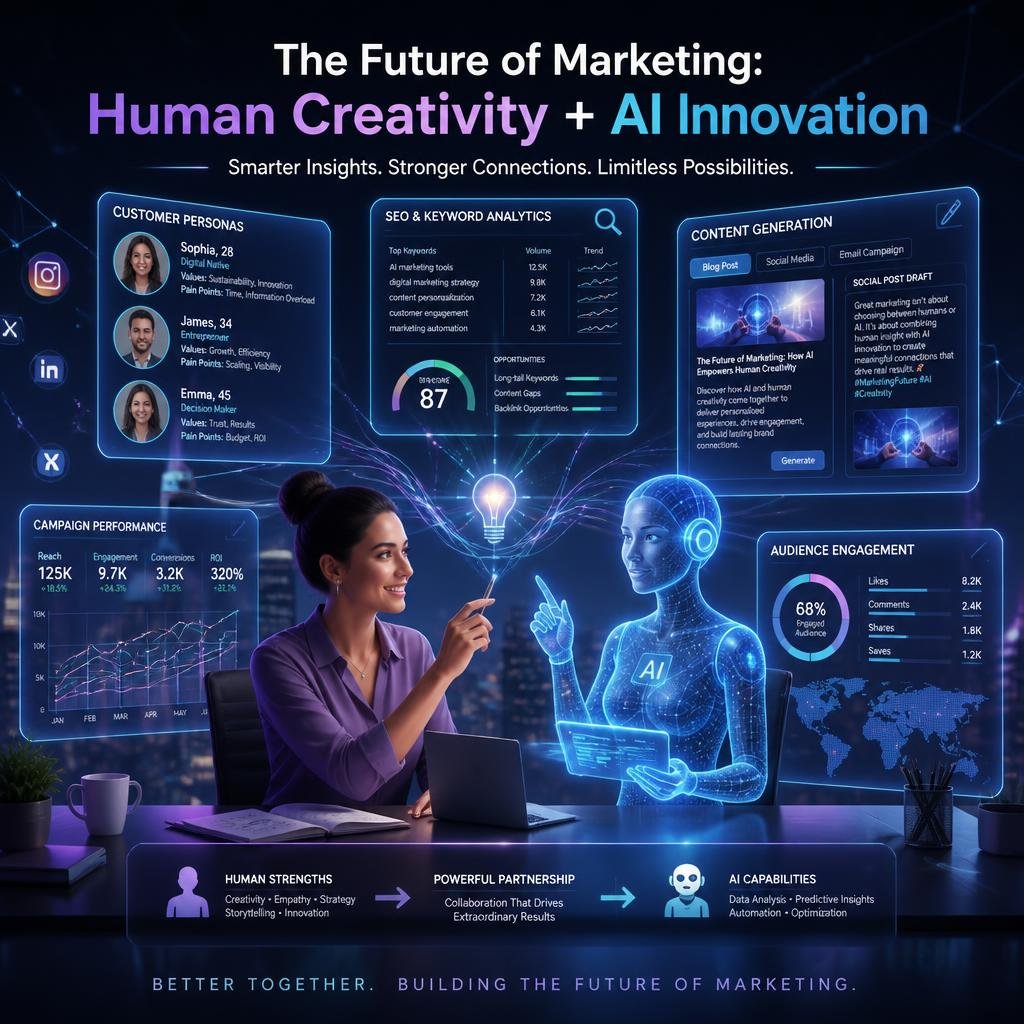
AI Image Generation Prompt: The Future of Marketing — Human Creativity Meets Artificial Intelligence
Create a visually striking, modern digital illustration representing the future of marketing through collaboration between human creativity and artificial intelligence. Show a marketing professional working alongside a holographic AI assistant in a futuristic, innovative workspace. The human represents imagination, strategy, emotion, and original thinking, while the AI represents data analysis, customer persona development, SEO optimization, and content generation.
Include floating holographic screens displaying customer persona profiles, SEO keyword analytics, social media content drafts, digital marketing charts, and audience engagement metrics. Illustrate glowing connections between human ideas and AI-powered insights to symbolize teamwork, innovation, and enhanced creativity.
In the background, incorporate subtle elements of the digital landscape, such as connected networks, social media symbols, digital dashboards, and abstract data streams. Use a sophisticated palette of electric blue, purple, white, and subtle teal accents, with clean lighting and a polished, professional atmosphere.
The composition should communicate that AI enhances human creativity rather than replacing it. Emphasize the partnership between human insight and AI capabilities as the driving force behind smarter marketing strategies and future innovation.
Style: Professional futuristic illustration, cinematic lighting, high detail, clean composition, realistic digital elements, visually engaging, suitable for a marketing presentation or educational project.
Suggested headline to include: “The Future of Marketing: Human Creativity + AI Innovation”
Aspect ratio: 16:9 widescreen. Ensure the design feels inspiring, forward-looking, and suitable for a professional business audience.